

Bridges Out of Poverty/Community Seminars
"The Bridges Out of Poverty training informs and enhances our Council's mission and equips staff and community with the best understanding of how to assist low-income people to facilitate responsible, self-directed decision making, planning, and ultimately self-sufficiency. After reviewing literally hundreds of tools, we believe that Getting Ahead and Bridges out of Poverty are significant additions to our long-term work to help people permanently leave poverty."

Tammy B. Schoonover, ACSW, LSW, Director of Training
Bucks County Opportunity Council, Inc.
Doylestown, Pennsylvania

In an effort to work with communities seeking long-term sustainability, Bridges Out of Poverty seminars are held in rotating locations around the country.

To receive additional information about any of our programs, please feel free to contact us at (800) 424-9484, or use our Contact Us page.

These seminars are also available as workshops at your organization. If you'd like to host a workshop at your organization, click here or call us at (800) 424-9484.

Training Seminars

Bridges Out of Poverty – Strategies for Professionals and Communities
Description:
"Now I understand the people I'm serving."

If you are looking to counter poverty in your community or its impact on people and businesses, explore the innovative concepts and training found in this workshop. This workshop will help your whole community build sustainable success.

Bridges Out of Poverty represents a powerful tool for change. Based in part on Dr. Ruby Payne's A Framework for Understanding Poverty, Bridges reaches out to the millions of service providers and businesses whose daily work connects them with the lives of people in poverty.

Bridges training contains case studies, detailed analysis, helpful charts and exercises, and specific solutions you and your organization can implement right now to:
  • Redesign programs to better serve people in poverty
  • Build skill sets for management to help guide employees
  • Upgrade training for front-line staff like receptionists, case workers, and managers
  • Improve treatment outcomes in healthcare and behavioral healthcare
  • Increase the likelihood of moving from welfare to work
The book Bridges Out of Poverty and a workbook of the same title are used as training manuals in the seminars and include chapters on relationship building, mentoring, redesigning programs, and community collaboration.

Testimonial:
"In the course of more than a decade of working with the unemployed and working poor in Cincinnati, we've found Ruby Payne's Bridges Out of Poverty the most useful book for helping our staff, Board of Trustees and possible funders understand the issues we confront on a daily basis with our members. It's required reading for those associated with Cincinnati Works. Dr. Payne's understanding of the mindset of the poor is unparalleled, and she does a marvelous job communicating why middle class "solutions" to poverty don't work."

– Liane Phillips, co-founder of Cincinnati Works, the nation's leading back-to-work program and co-author of the forthcoming book WHY DON'T THEY JUST GET A JOB: Business Solutions to Poverty From Cincinnati Works, the Nation's Leading Best Practices Back-to-Work Program
Length:One Day
Prerequisite:None
 Register/See training dates
Back to Top Link: #bridges

Bridges and Circles National Community Building Conference
Description: DeVol's State of the State Address: Bridges Community of Practice

Here's an event to collaborate with others working to build sustainable communities. Come hear about other's best practices, and share yours. The Bridges and Circles National Community Building Conference is where new and established Bridges and Circles Communities come together to share knowledge and experience in the work of ending poverty.

There are pathways out of poverty that are interwoven and yet distinct. We have specific tracks at the conference for these pathways, which include Getting Ahead, College, Business, and Bridges/Circles.

Gain a deeper understanding, explore new tools, and learn the latest innovations and strategies.

 Register/See training dates
Back to Top Link: #bridges_circles

Getting Ahead in a Just-Gettin'-By World E-Training
Description: Get certified in Getting Ahead—without having to pay for travel—in the convenience of your own office!

Getting Ahead facilitates a process for people from poverty to investigate the impact that poverty has had on themselves and their community and to use this information to build resources for a better life and community.

Learn how to use the Getting Ahead in a Just-Gettin'-By World workbook for adults in poverty. This program shows them how to use the hidden rules of class to build up financial, emotional, social, and other resources. Understanding the hidden rules of middle class and wealth, and choosing to use them, can open doors to such resources as new relationships and new jobs, among others.

Facilitator training includes the following topics: philosophy, theory, motivation and incentives, long-term support, mental models, content and process, and practice sessions.
Length:One day, or can be adapted for keynote
Prerequisite:
  • Must have attended a Bridges Out of Poverty workshop
  • Must read the first 18 pages of the Getting Ahead facilitator notes prior to the event
Value:
  • Receive a copy of the PowerPoint slides
  • Preparation to facilitate Getting Ahead groups
  • Personalized follow-up coaching
  • Receive a Getting Ahead workbook and facilitator notes set
Requirements:
  • Attend both sessions
  • Complete the learning task assigned during the first session before the start of the second session
  • Headphones and a computer equipped with a microphone (or a combination headset)
 Register/See training dates
Back to Top Link: #ga_etraining

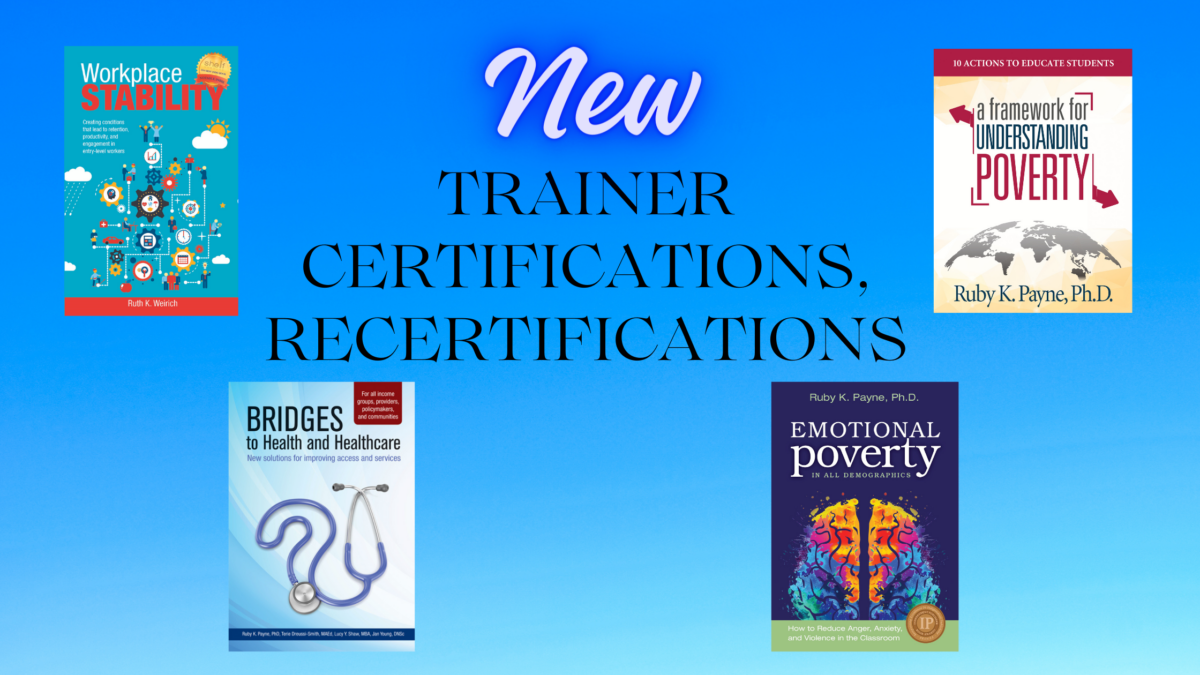
Trainer Certification Seminars

Bridges Out of Poverty - Trainer Certification
Description:
Become a certified trainer!

This seminar is designed for individuals who wish to become Certified Bridges Trainers in order to take the information back to their organizations. The training includes in-depth work on the Bridges Out of Poverty (Day One) and Applying Bridges Concepts (Day Two) seminars. Topics also include instructional techniques and the power of story–all intended to help trainers tailor the program to the needs of their particular organization. Comprehensive research and training materials are provided.
Length:Three days
Prerequisite:Bridges Out of Poverty workshop, or Bridges Out of Poverty audio workshop kit
 Register/See training dates
Back to Top Link: #bridges_trainer

Getting Ahead™ in a Just-Gettin'-By World
Description: Getting Ahead™ in a Just-Gettin'-By World is a workbook for people in poverty that shows how to use the hidden rules of class to build up financial, emotional, social, and other resources. Understanding the hidden rules of the middle class and wealth, and choosing to use them, can open doors to new relationships, new jobs, and higher resources.

Working in a group with a facilitator, people who use this workbook will develop a series of mental models to examine their own lives and create new future stories. In 15–20 sessions, participants explore the impact that poverty has had on them, investigate economic realities, complete a self-assessment of their own resources and make plans to build them, and develop a mental model of community prosperity.

The Getting Ahead™ process does not provide answers to the participants on how to establish economic stability, nor does it make the argument for change. Instead, motivation, insight, and plans come from the participants themselves. Upon completing Getting Ahead, participants will have a plan of their own based on the knowledge acquired through the co-investigative process and expressed in new mental models.

Getting Ahead™ offers Dr. Ruby Payne's concepts, which are familiar to educators and social service providers across the country, directly to people in poverty.

Audience: People training to be Getting Ahead facilitators.

Audience Size: Limited to 70 participants.

Needs/issues/problems addressed in this workshop:
  • Community collaboration
  • Parents
  • Poverty
Workshop options:
  • One-day
  • Two-day
  • Six hours of e-Learning in two-hour increments
  • Online professional development in two-hour increments
Prerequisites (for facilitators): Bridges Out of Poverty or A Framework for Understanding Poverty.
 Register/See training dates
Back to Top Link: #ga_trainer

Higher Ed: Investigations Into Economic Class in America (IECA)
Description: This training prepares participants to offer the Investigations curriculum to under-resourced college students. Participants explore the content processes and sequences within the text and develop the facilitation skills that allow students to take on the role of knowledge-creator. The training format provides opportunites to design implementation models that address the needs of specific populations and build on institutional strengths.

Benefits:
  • Fundamentally different approach to entry-level student support strategies
  • Trusts the students to analyze their situation, solve problems, and transform their lives and their community
  • Students develop the knowledge to meet their own needs even as they gain a better understanding of what their needs are, which generates transformational change
  • Examines and addresses the realities of political/economic systems that contribute to poverty
Audience: College faculty, administrators, staff (student services and others who work with students in a teaching/advising role), and community members with a strong interest in working with under-resourced students.

Needs/issues/problems addressed in this workshop:
  • Higher education
  • Under-resourced students
  • Student retention and completion
  • Student success
Workshop options:
  • One-day
  • Offered as optional fourth day of training following the Understanding and Engaging Under-Resourced College Students
Prerequisite: A Framework for Understanding Poverty, Bridges Out of Poverty, or Understanding and Engaging Under-Resourced College Students.
 Call (800) 424-9484 or email us with questions or to book this workshop. 
Back to Top Link: #hed_ieca_cert

Higher Ed: URCS/IECA Trainer Certification
Description: Become a certified trainer in higher education!

This seminar prepares individuals to present the information from Understanding and Engaging Under Resourced College Students (URCS) to faculty and staff in their own colleges and universities. The training is recommended for faculty and staff of postsecondary institutions that want a systemic, research-based approach to improving retention and completion rates for their most at-risk students.

Participants will gain a deeper understanding of the challenges and strengths that students from poverty bring to the college campus; new strategies to help these students succeed in the classroom, on campus, and in life; tips and tactics for creating a college environment that supports under resourced students; and insight into harnessing the potential of under resourced students to effect positive change, on campus and in their communities.

In-depth research, instruction, and training materials prepare participants to provide ongoing training to faculty and staff in their colleges or universities.

Prerequisites: Understanding and Engaging Under Resourced College Students, Bridges Out of Poverty, or A Framework for Understanding Poverty.

Audience: Recommended for faculty and staff of postsecondary institutions.

Workshop options:
  • Three days
  • Optional fourth day for training leading to certification as a facilitator of Investigations into Economic Class in America (IECA).
Needs/issues/problems addressed in this workshop:
  • Trainer Certification
  • Higher Education
 Call (800) 424-9484 or email us with questions or to book this workshop. 
Back to Top Link: #hed_urcs_cert

For schedule, all locations and pre-registration, visit our Training Dates page. To receive additional information about any of our programs, please feel free to contact us at (800) 424-9484, or use our Contact Us page.
Return to Home Page